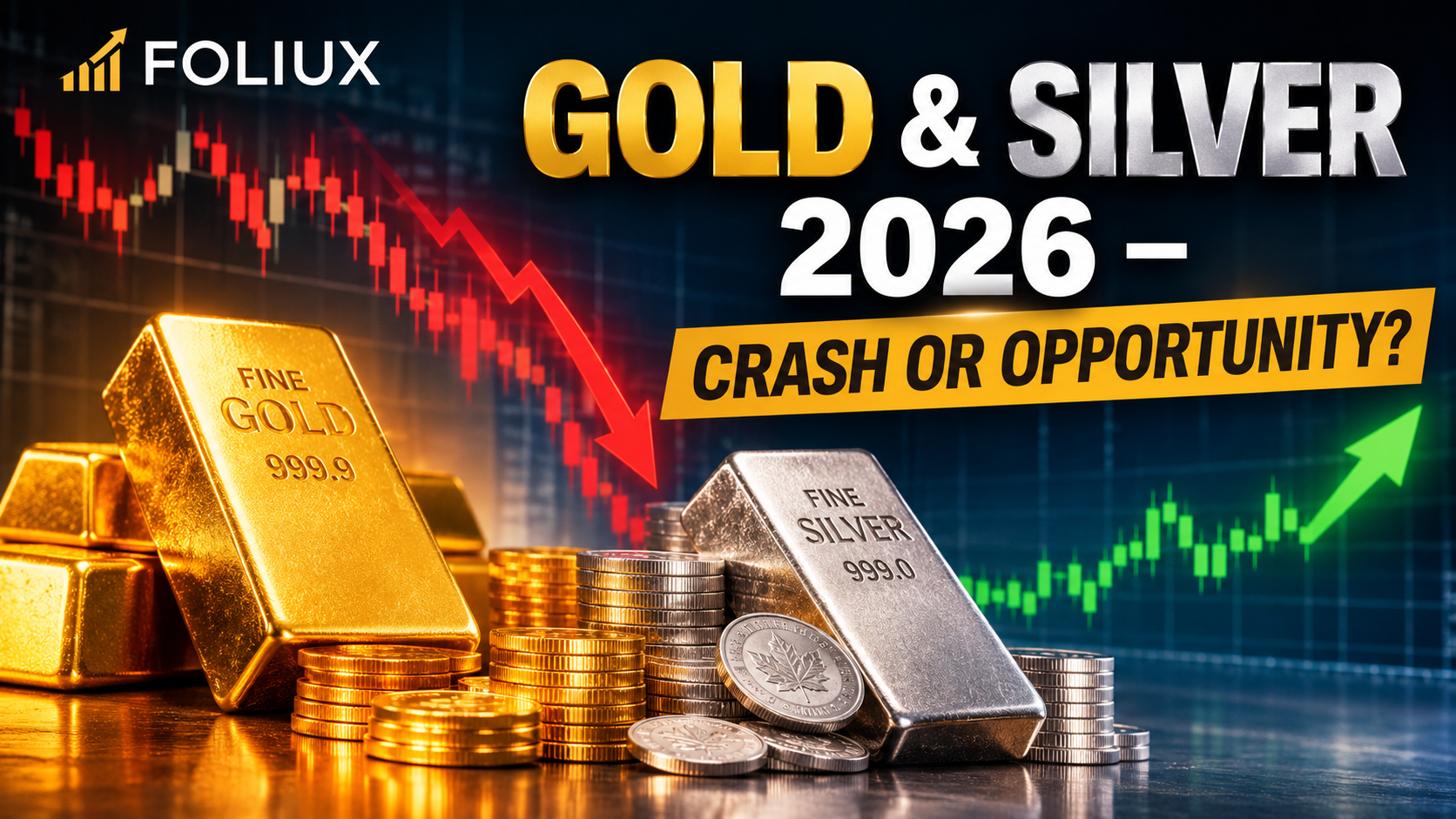
Gold and Silver Price Crash in 2026: Is This a Buying Opportunity or a Warning for Investors?
Gold and silver have always played an important role in wealth preservation and portfolio diversification. However, 2026 has been a surprising year for precious metal investors. After delivering extraordinary returns in 2025, both metals experienced a significant correction from their January 2026 peaks.
For investors who entered the market at higher prices, this correction may have been uncomfortable. However, for long-term investors, it also raises an important question: Is the current fall an opportunity to accumulate gold and silver, or is it a warning that the rally has ended?
At FOLIUX, we believe investment decisions should be based on market fundamentals, risk management, diversification and disciplined allocation rather than short-term market movements.
1. Gold and Silver: From Historic Rally to Sharp Correction
2025 was an exceptional year for precious metals. Gold and silver delivered some of their strongest annual performances in decades. However, the situation changed significantly in 2026.
| Performance | Gold (USD) | Gold (INR) | Silver (USD) | Silver (INR) |
|---|---|---|---|---|
| Calendar Year 2025 | +67% | +75% | +149% | +167% |
| Fall from January 2026 Peak | -21.4% | -14.9% | -51.4% | -45.3% |
Source: FactSet and MCX spot price data, as reported in November 2026 market commentary.
The figures highlight an important difference: silver experienced a much sharper correction than gold. This demonstrates why investors should not treat gold and silver as equally risky investments. Silver generally experiences greater price volatility.
2. Why Did Gold and Silver Prices Fall in 2026?
Several factors contributed to the correction.
A. Higher US Interest Rates
Gold does not generate interest or dividends. When interest rates rise, investors may prefer interest-bearing investments such as government bonds.
Expectations of higher US interest rates strengthened the dollar and increased pressure on precious metals.
B. Profit Booking and Leveraged Positions
After the extraordinary rally in 2025, many investors had accumulated substantial profits.
When prices started falling, leveraged traders were forced to close positions because of margin calls and stop-loss orders. This increased selling pressure. Silver experienced particularly sharp selling during this period.
C. Stronger US Dollar
Gold is internationally traded in US dollars. A stronger dollar generally makes gold more expensive for buyers using other currencies and can reduce international demand.
D. Inflation and Geopolitical Developments
Higher oil prices and geopolitical tensions created concerns about inflation and interest rates.
Although geopolitical uncertainty traditionally supports gold, its impact can be complicated when higher energy prices also increase expectations of tighter monetary policy.
3. Why Did Indian Gold Investors Experience a Smaller Fall?
One interesting observation is that Indian gold prices did not fall as much as international gold prices.
There are two important reasons:
- Rupee depreciation: The Indian rupee weakened against the US dollar during 2026. Since international gold prices are quoted in dollars, a weaker rupee provides some support to domestic gold prices.
- Import duty: The increase in gold import duty, as reported in the market commentary, also supported domestic prices.
However, investors should understand that these benefits are not permanent. A stronger rupee or a reduction in import duty could create additional pressure on Indian gold prices.
4. What Could Drive Gold Prices in the Coming Months?
Central Bank Buying
Central banks continue to consider gold an important reserve asset. Countries such as China, Poland and Uzbekistan have continued accumulating gold. Institutional demand can provide long-term support, particularly during market corrections.
US Federal Reserve Interest Rate Decisions
The direction of US interest rates is one of the most important factors for gold.
If the Federal Reserve stops increasing rates earlier than market expectations, the US dollar and bond yields could weaken. This may create a favourable environment for gold.
However, if inflation remains high and interest rates rise further, precious metals could experience additional volatility.
Geopolitical Uncertainty
Conflicts, international trade tensions and concerns about global financial stability continue to support gold's role as a safe-haven asset.
Unlike currencies and government bonds, physical gold does not represent a liability of another institution.
Gold ETF Investment Flows
Institutional and retail participation through gold ETFs is another important indicator. Increasing ETF investments may indicate that long-term investors are using price corrections to build positions.
5. Gold vs Silver: Which Is Better for Investors?
Both metals have different characteristics and investment purposes.
| Factor | Gold | Silver |
|---|---|---|
| Price Volatility | Comparatively lower | Higher |
| Main Demand | Investment and jewellery | Industrial and investment |
| Portfolio Role | Core diversifier | Higher-risk complement |
| Correction Risk | Moderate to high | High |
| Investment Approach | Long-term allocation | Controlled allocation |
Our perspective: Gold can be considered the core precious-metal allocation for investors seeking portfolio diversification. Silver may complement gold, but its higher volatility requires additional caution.
6. Should You Invest in Gold and Silver Now?
There is no guaranteed way to identify the exact bottom of a commodity market.
Instead of investing the entire amount at once, investors can consider a staggered investment approach.
- Avoid investing a large amount only because prices have corrected.
- Consider spreading investments across multiple purchase levels.
- Maintain a reasonable allocation to precious metals within the overall portfolio.
- Evaluate gold ETFs and silver ETFs as alternatives to holding physical metals, considering their costs and tracking differences.
- Avoid leveraged trading and speculative positions.
- Review your allocation periodically rather than reacting to daily market movements.
Remember that even after a significant correction, prices can fall further.
7. How Much Gold and Silver Should Be in Your Portfolio?
The appropriate allocation depends on an investor's financial goals, investment horizon, risk tolerance and existing assets.
An investor who already holds substantial physical gold or property may not need additional exposure through ETFs.
Similarly, someone with a large equity portfolio may consider precious metals as a diversifier rather than as the primary investment.
The objective should be to maintain balance across asset classes.
At FOLIUX, we emphasise disciplined investing and diversification. Our approach is to avoid over-investing in any particular stock, ETF or asset category and to consider the overall portfolio before making investment decisions.
8. FOLIUX Outlook: Long-Term Opportunity, Short-Term Volatility
Our assessment is that the long-term investment case for gold remains supported by central bank demand, geopolitical uncertainty and concerns about global financial stability.
However, the short-term direction will depend heavily on US interest rates, inflation, currency movements and global economic developments.
Silver may offer opportunities during a broader precious-metal recovery, but investors must be prepared for larger price fluctuations.
Rather than attempting to predict every market movement, investors should focus on:
- Maintaining proper asset allocation.
- Avoiding excessive concentration in one investment.
- Investing in stages during volatile periods.
- Keeping sufficient liquidity for financial requirements.
- Reviewing portfolio performance and risk regularly.
Final Thoughts
The 2026 correction in gold and silver is an important reminder that even traditionally valuable assets can experience substantial price fluctuations.
A falling market does not automatically mean an investment is attractive, just as a rising market does not guarantee future returns.
Successful investing requires patience, diversification and a disciplined approach to risk management.
At FOLIUX, our philosophy is simple: Track your investments, understand your risks and build wealth through disciplined investment decisions rather than market speculation.
Disclaimer
This article is for educational and informational purposes only. It does not constitute investment advice or a recommendation to buy or sell gold, silver, ETFs or any other financial instrument. Precious metals carry market risk, and investors should assess their financial goals and risk tolerance before investing.
FOLIUX – Investment Tracking System
Rule-based investing for disciplined wealth creation.


No comments yet. Be the first to share your thoughts!
You must be logged in to write a comment.
Log In to Comment